 303-825-2223



;)
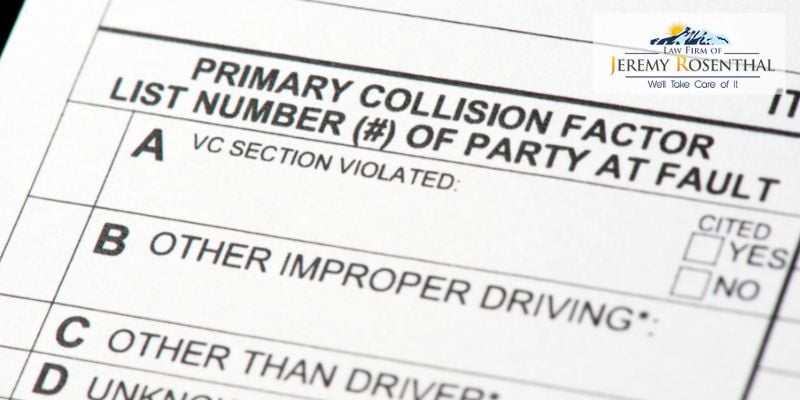
Police Reports in Colorado
One of the cardinal rules of correctly handling an injury after a car accident is to immediately contact law enforcement authorities so that they can arrive on the scene to assess the situation and help restore order. An important product of this appearance on the part of the police is the accident report that will be generated and filed. In it will likely be information about the parties involved, the prevailing road and weather conditions at the time of impact, and possibly a statement about which driver or drivers shoulder the responsibility for what occurred. While generally speaking, a report of this nature will not be admissible in court should litigation become necessary, it can prove extremely helpful to victims seeking to obtain financial compensation from the at-fault motorist’s insurance carrier. Denver injury attorney Jeremy Rosenthal possesses vast experience in using police reports in Colorado to great advantage in his work on behalf of accident victims.

Making the Most of Police Reports
Once an accident occurs, it is important for victims to obtain any and all reports produced by responding law enforcement officers. This can be done simply by calling the relevant agency or perhaps by using online request forms available in many jurisdictions. Again, these sorts of documents are not likely to be admissible as part of a lawsuit, but they play a very valuable role when it comes time to negotiate with insurance adjusters. When combined with medical records and other key documentation, police reports can form the basis of an effective demand letter that can be sent to the responsible driver’s insurer. A police report that assigns blame to another driver will often serve as tremendous leverage in obtaining far more compensation than might otherwise be offered by a carrier determined to minimize or even deny valid claims in Colorado.
Important Information Contained in Police Reports
In addition to indications of fault pertaining to a Colorado auto accident, a police report often includes a great deal of other valuable information that can be used to force the hand of an otherwise stubborn insurance adjuster. It will likely provide impartial restatements of facts such as the weather conditions at the time of the event, the state of the road on which the accident occurred, visible damages, and the names and recollections of eyewitnesses on the scene. Though settlement through negotiation is always preferable to litigation, the individuals listed on the police report as having seen the accident unfold can be called as witnesses in a deposition or at a trial, something insurance carriers will perhaps view as a risk they would like to avoid.
Painting a Comprehensive Damage Picture
As suggested earlier, the rules of evidence will typically preclude the admission of a police report in a trial situation. However, these reports go a long way toward building a complete picture of what happened at the time of the accident and who was to blame. When combined with other types of essential documentary evidence such as medical records, accident scene photographs, wage loss data, and the like, police reports often make it possible to secure a much more beneficial settlement than might have been achievable in their absence.
Can I File a Claim Without a Police Report?
Many people wonder whether the absence of a police report means the end of their claim. The good news is that Colorado law does not require a police report before you can file an insurance claim or pursue compensation from the driver who caused your crash. Circumstances often prevent a report from ever being generated. For example, under Colorado Revised Statutes § 42-4-1606, an officer generally is not required to investigate or file a report when property damage appears to be one thousand dollars or less, and no one was injured. Officers responding to high call volumes in the Denver metro area may also decline to respond to minor collisions, directing drivers to file an online report instead, or in some cases, no report is filed at all. At Rosenthal Injury Law, we regularly help clients build strong claims even when no responding officer ever arrived at the scene.
That said, filing a claim without a police report typically means you and your attorney must work harder to establish what happened and who was responsible. This is where having direct access to your attorney, rather than being passed between paralegals and case managers, becomes especially valuable. Jeremy Rosenthal works personally with clients from the very beginning of a case, which allows him to identify gaps in the evidence early and address them before an insurance adjuster can use those gaps against you.
What You Need Instead
When no police report exists, other forms of evidence must carry more of the weight. The following can help establish fault and damages in place of an official report:
- Photographs of both vehicles, the roadway, and any visible injuries
- Contact and insurance information for every driver involved
- Names and phone numbers of anyone who witnessed the collision
- A written account of the accident recorded as soon as possible
- Medical records documenting treatment received after the crash
- Dashcam footage or nearby surveillance video, if available
- Repair estimates or invoices from a body shop
- Text messages or call logs confirming when the accident was reported to insurers
Gathering this information quickly matters. Memories fade, surveillance footage is often overwritten within days or weeks, and vehicles get repaired before damage can be documented. Our team can help you request footage from nearby businesses, track down witnesses, and organize your documentation into a clear timeline that supports your claim.
Potential Challenges in a Case
Without a police report, insurance companies sometimes take a more aggressive stance when disputing fault. An adjuster may argue that there is no independent record of what occurred, or may attempt to shift blame onto you in hopes of reducing what they must pay. Rideshare and commercial vehicle accidents can raise additional complications, since multiple insurance policies, and sometimes multiple companies, may be involved. Having an attorney who reviews the facts directly, rather than relying solely on a report, helps you respond to these tactics with organized proof rather than guesswork.
It is also important to keep Colorado’s filing deadlines in mind. Under Colorado Revised Statutes section 13-80-101(1)(n), most car accident injury claims must be filed within three years from the date of the crash, regardless of whether a police report exists. Waiting too long to gather evidence, or to speak with an attorney, can make it harder to reconstruct what happened and may jeopardize your ability to recover compensation at all. Reaching out early, even before you have collected every document, allows us to start building your case while the details are still fresh.
Contact a Colorado Injury Advocate About Police Reports After Accidents
When it comes to gathering, maintaining, and effectively assembling evidence in a personal injury case, victims often feel unprepared and overwhelmed. Attorney Jeremy Rosenthal pledges to provide such individuals with the uncompromising client service, attention to detail, and aggressive legal advocacy they deserve. To schedule a no-cost initial consultation and learn more about police reports in Colorado, contact us at 303.825.2223.